
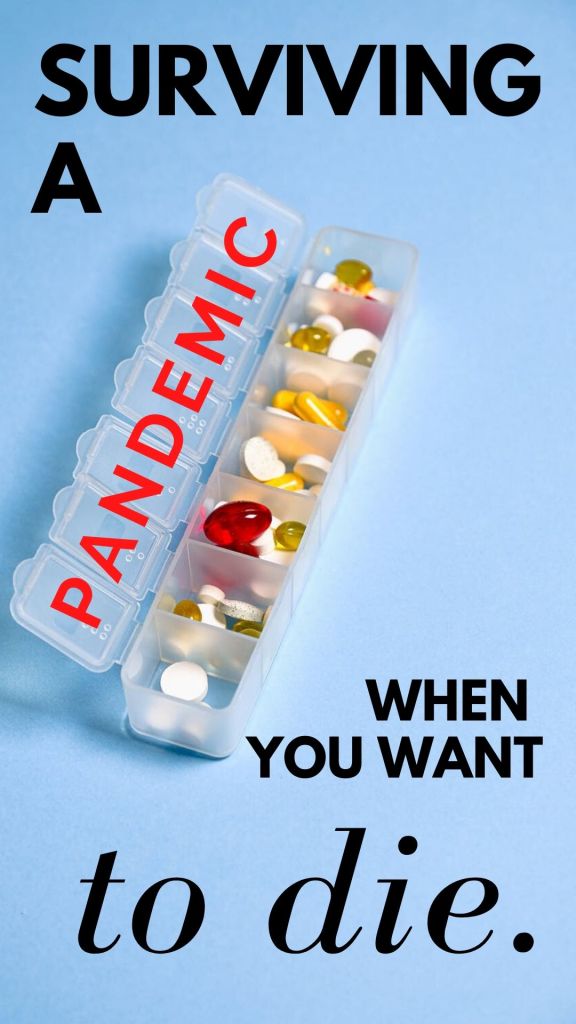
PHOTO CREDIT: RACHEL FRANKEL FOR LIFEEXPIRED.COM
TRIGGER WARNING: The following post contains material related to mental health issues, depression, anxiety, PTSD and suicide. Please read at your own discretion– and bear in mind that no one would be better off if you were dead.
“If COVID wasn’t contagious… I’d be licking public toilet seats.”
Three texts sat on my phone’s home screen page for nearly 48 minutes, waiting patiently to be read while I whirred around my kitchen in an orchestra of tomato sauce and red wine. I’d been conversing with an old friend from my previous college, bonding over the disarray of converted online classes and ancient teaching methods. She asked how my dog was doing now that I was spending all day at-home during the coronavirus outbreak. I asked her if she would be fostering a cat.
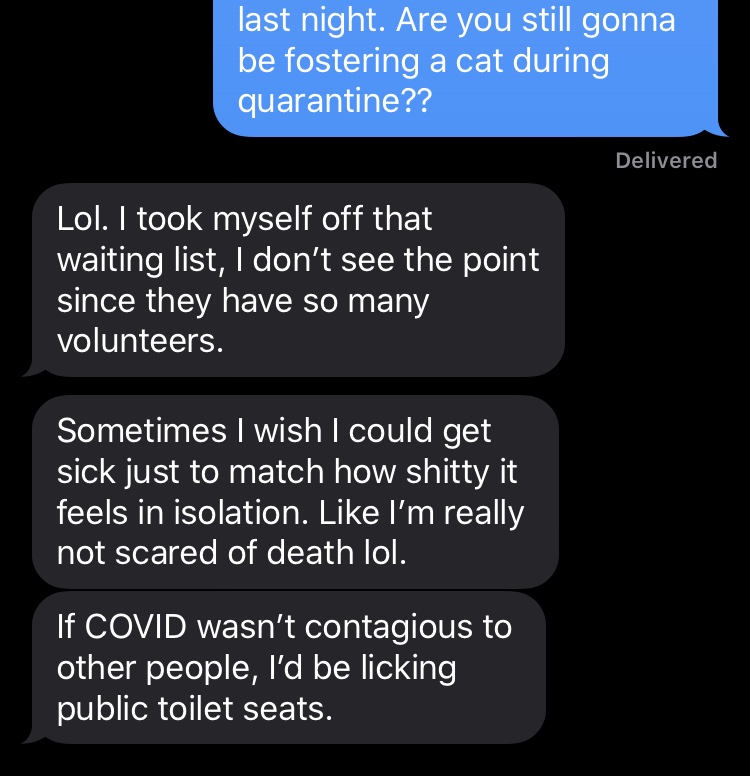
PHOTO CREDIT: RACHEL FRANKEL FOR LIFEEXPIRED.COM
78 characters and a (mediocre) pasta puttanesca later, I felt a sharp jab at both my dark sense of humor and my DANGER-WILL-ROBSINSON intuition. A text like this would’ve earned dozens of “haha” reactions, 😂😂😂crying laughing emojis, and “honestly same”s from a standard college student group text. But when a twinge of legitimacy hides under an otherwise unassuming message, the choice of response turns from playful –often unknowingly– to crucial.
Know when to discern humor from reality.
At 19, I got a voicemail from an area code I didn’t recognize. I shrugged it off as an all-too-tenacious telemarketer from Illinois. Two days later, I got another call. A friend had hung herself and died.
About a week after her funeral (in Chicago, Illinois), I opened that strange number’s voicemail. It was left by my friend. She made some casual comments about getting a new number, how I probably thought it was a crazy stalker trying to reach out or a telemarketer. The message ended with a friendly call-me-whenever-you-get-this, adding a haunting final remark:
“So much crazy stuff has happened the last few days, so if I don’t get back to you first– I got into the arsenic instead lol.”
It was a joke about self-destruction that got echoed by thousands of others on a daily basis. But this time it wasn’t funny. How is it then, that anyone could discern humor from reality– especially when we all live in a disturbingly self-deprecating world?
There’s no such thing as comedian without cause.
While most signs of suicidal thoughts may seem glaringly obvious like giving away one’s valuables, speaking about one’s future as though they aren’t a part of it, isolating from friends and family, becoming noticeably more withdrawn or depressed, etc., the sign that goes by often dangerously unnoticed is the persistent use of suicide jokes in conversation. According to an article by Stanford Children’s Health, repeatedly engaging in conversations about suicide– even jokingly– was a key warning sign in identifying suicidal thoughts and tendencies in teens and young adults.
When suicide-attempt survivors in British Colombia were asked if they’d told someone of their plans to die, the answer among all survivors was a resounding “yes.”
Listen when someone tells you they want to die. We have to resort to using “taking one’s life” or “self-destruction” just to talk about suicide, and it’s easy for conversations that simply discuss the topic to feel taboo. For someone who is suicidal, joking about death may serve as an outlet for them to express how they really feel about dying without the serious undertone. They can gauge their audience’s reaction to the joke and retreat to “I’m just KIDDING, god!” if their response is met with apprehension.
So– amidst a global pandemic where survival rates are being squeezed into the media forefront every waking day– what should you do if you can’t stop thinking about wanting to die?
1.) Make a list.
PHOTO CREDIT: ENERGEPIC.COM VIA PEXELS
No, not a list of hopes and dreams and positive manifestations you aspire to be– that list is already sitting in an unopened journal at the bottom of your closet. Instead, write a list of three things (minimum) that you need to get done today, whatever that means for you. If you’ve already done the bare necessities for your well-being like personal grooming and making breakfast, congratulations– you’re ahead of the curve. But if you haven’t, this list can be the difference between the smallest twinge of satisfaction, and the most overwhelming feeling of failure. Whether your list is as extravagant as:
- Hand whip coffee
- Dry clean gowns
- Home make soufflé
Or as critical as:
- Shower
- Eat
- Brush teeth
Writing those three things down can offer even a nominal sense of control, especially when the thought of facing another day of tasks feels overwhelming at best. That hint of pride from crossing tasks off is just the cherry on top.
2.) Realize you’re not that unique.
PHOTO CREDIT: WILLSANTT VIA PEXELS
Did I really just suggest, to a potentially suicidal person, that you’re not really all that special? In case you haven’t heard, the world population almost stands at 8 billion people. Maybe no one else has your exact DNA or knows each and every thought you’ve ever had– but the feeling of being alone is far from unique. While nearly 50,000 people died as a result of their suicide attempt last year, a figure that’s already 50,000 people too high, over a million more made a suicide attempt and survived. 2017 data from the National Institute of Mental Health shows that:
9.8 million Americans seriously consider ending their lives every year.
9,800,000 people. Every year.
While suicidal thoughts aren’t exactly an ideal shared experience, understanding that suicidal thoughts aren’t rare is a crucial experience, because millions of other people really do feel the same way as you. It may seem like you’re the only one who could possibly feel this burden right now, but even acknowledging the prevalence of suicidal thoughts among the masses can help you recognize you’re not really so alone.
3.) Volunteering transforms pain
PHOTO CREDIT: HELENA LOPES VIA PEXELS
If you’ve convinced yourself that you’re too insignificant, meaningless, or worthless to be saved by the above suggestions, then riddle-me-this batman: what do you have to lose by saving the lives of others?
Non-profits are in crisis.
With a plethora of organizations now in dire need of volunteers amidst the COVID-19 outbreak, there is a growing demand for anyone who is ready to serve their community. While the screenshot at the beginning of this article showed my friend’s discouragement around the “so many volunteers” who’d applied to the same cat foster program, not every organization is so lucky. According to a press release from the American Red Cross, as the novel coronavirus continues to spread, the organization expects to see a decrease in those eligible (and willing) to donate blood. In case you didn’t know, volunteers are the only source of blood for life-saving patient transfusions.
“But what if my physical heath sucks and no one wants my blood?”
You’re not out of the woods yet my friend. As of right now, over 230,000 volunteers are still needed for thousands of virtual jobs during the pandemic. Do you write? Do you draw? Do you read? Do you breathe? There’s an organization that needs your help, right now, regardless of what you think you (don’t) have to offer. There’s a reason that patients diagnosed with chronic pain disorders are often referred to volunteer work: enriching the lives of others *literally* transforms internal pain, physiologically and psychologically. If you can’t see the point in living another day for “just” yourself, imagine the difference a day could make saving the life of someone else.
4.) This too shall pass.
PHOTO CREDIT: MOOSE PHOTOS VIA PEXELS
Did it take an incredible amount of restraint *not* to use a picture of a twenty-something-year-old white woman with this quote tattooed on her wrist? Yes it did. But cliches aside, the phrase doesn’t lie.
Your mind is lying to you.
While most of us have our memories dipped in rose-colored hues, the suicidal brain would rather dunk these memories in arsenic. Why is it so hard to remember life outside of wanting to die?
You haven’t always been in a world devoid of hope and joy.
Hundreds of times you’ve laughed so hard, sometimes just from others laughing around you, that your eyes have welled with tears. You’ve taken a bite of something new that was so-frickin-good, only that one restaurant knows how to make it right. You’ve taken that quick breath through your teeth when freezing ocean water hit your feet, and continued running as close as you could to the waves without touching them. You’ve been on a road trip so early in the morning that you’ve seen the sun rise, and you’ve dozed back to sleep in the passenger seat shortly after. You’ve made eye contact with a baby at the grocery store, and you’ve tried not to laugh when they giggled and smiled back.
Life wasn’t always like this, and it will never be like this again.
Every moment of everyday is fleeting and unable to be duplicated; which also means you’ll never feel exactly the same as you did today. I know you think this mental state is unescapable, that life will never move past this, that you were doomed from the start to be a hostage to your own brain. So if you don’t have anyone in quarantine to hound this concept into your noggin, let me do it for you:
You’re wrong.
You think no one has ever experienced this pain and that no one can help you, but you’re wrong. You think you’ll never get through this quarantine, but you’re wrong. You think your brain will be stuck like this forever, consumed by thoughts of wanting to be any place but alive and alone; but you’re wrong. Every ounce of scientific research, every CT scan, and every piece of peer-reviewed psychological advice can prove that your mind is playing roulette with your will to live– so stop placing bets against yourself. With the utmost confidence, and odds than are 100 to none, I know for a fact you won’t feel like this forever.
If you can’t stop the cycle of feeling better-off-dead:
- Write down what you would tell a parent, sibling, friend, teacher, or even a future child if they told you the world would benefit from their death. Fight through tooth and nail to remind yourself, logically, why your death would actually ruin the lives of everyone around you. Fight to remind yourself of the despair you feel at your worst– and ask yourself if you’d really wish that upon everyone you’ve ever cared about in your life.
5.) Understand that “normal” is just a setting on your dryer.
PHOTO CREDIT: Gratisography VIA PEXELS
In case the state of 2020 thus far hasn’t been convincing enough– the emergence of the most destructive fires in Australia, the death of Kobe Bryant, the impeachment trial of a reality TV host/president, the damn near beginning of WWIII, the succession of royalty from Prince Harry and Princess Di Duchess Meghan Markle, the conviction of Harvey Weinstein, the faked death of Kim Jong Un, and now the development of the formidable “murder hornet” arriving in the U.S.– normal is just a setting on your dryer.
I honestly don’t know why you want to kill yourself. Maybe you don’t even want to die, so much as you want to stop living. Maybe you have depression, anxiety, PTSD, bi-polar disorder, schizophrenia or an issue with substance abuse. Maybe you don’t and you never have. Maybe you think you don’t have any living relatives to mourn your death. Maybe you have a mother, a father, a sibling, a spouse, and a child.
There is no such thing as normal circumstances surrounding the thought of ending your life.
Alternatively, there is no such thing as normal circumstances surrounding the life you choose to live. We’re all figuring this out as we go so if you’re “acting normal” to mask the thoughts (you think) your friends and family would never understand, roll those dice and try again. The only way to get out of the scary place you’re in is to actually acknowledge you’re there– and to admit that you don’t want to extend your stay.
Reaching out?
Even if none of the suggestions above have resonated with you, talking to friends and family about your thoughts of wanting to die is the one coping mechanism noticeably absent from this article. This omission isn’t to suggest that reaching out isn’t effective– in fact, talking about your suicidal thoughts is one of the most beneficial things for your recovery. But to me, that suggestion runs parallel to telling an alcoholic the most beneficial thing for their recovery is to stop drinking. You know what needs to be done to mitigate the problem– but you also need the confidence to make the decision to reach out on your own. If ever the confines of quarantine feel too devastating or overwhelming to deal with by yourself, you don’t even need to talk on the phone to get 24/7 help.
“Social distancing may feel lonely, but you don’t have to be alone.”
CRISIS TEXT LINE, 2020
If you’d rather start by reaching out over text instead of voice call, Crisis Text Line was developed to respond to people in psychological need.
Text HOME to 741741, 24 hours a day, seven days a week, if you ever need to chat with a trained crisis counselor about whatever you’re going through.
And they’re not reserved as a “suicide-only” hotline; Crisis Text Line has counselors trained on COVID-19 anxieties, seasonal depression, emotional abuse, and any other number of issues that place you in a state of crisis. Whether you chat with an anonymous stranger or choose to text with a friend, keep choosing to reach out when life becomes unmanageable. Make informed decisions about behaviors that can help transform your mental health for the better, and remember: absolutely no one would be better off if you were dead.
 Life Expired.
Great Messages to Every Person regardless of Age, Politics, Gender or Faith
LikeLike
I find my self recognizing a wonderful voice in your writing. While our relationship may not be consistent, I am proud to call you my niece.
LikeLike